STEM Trainer Provision
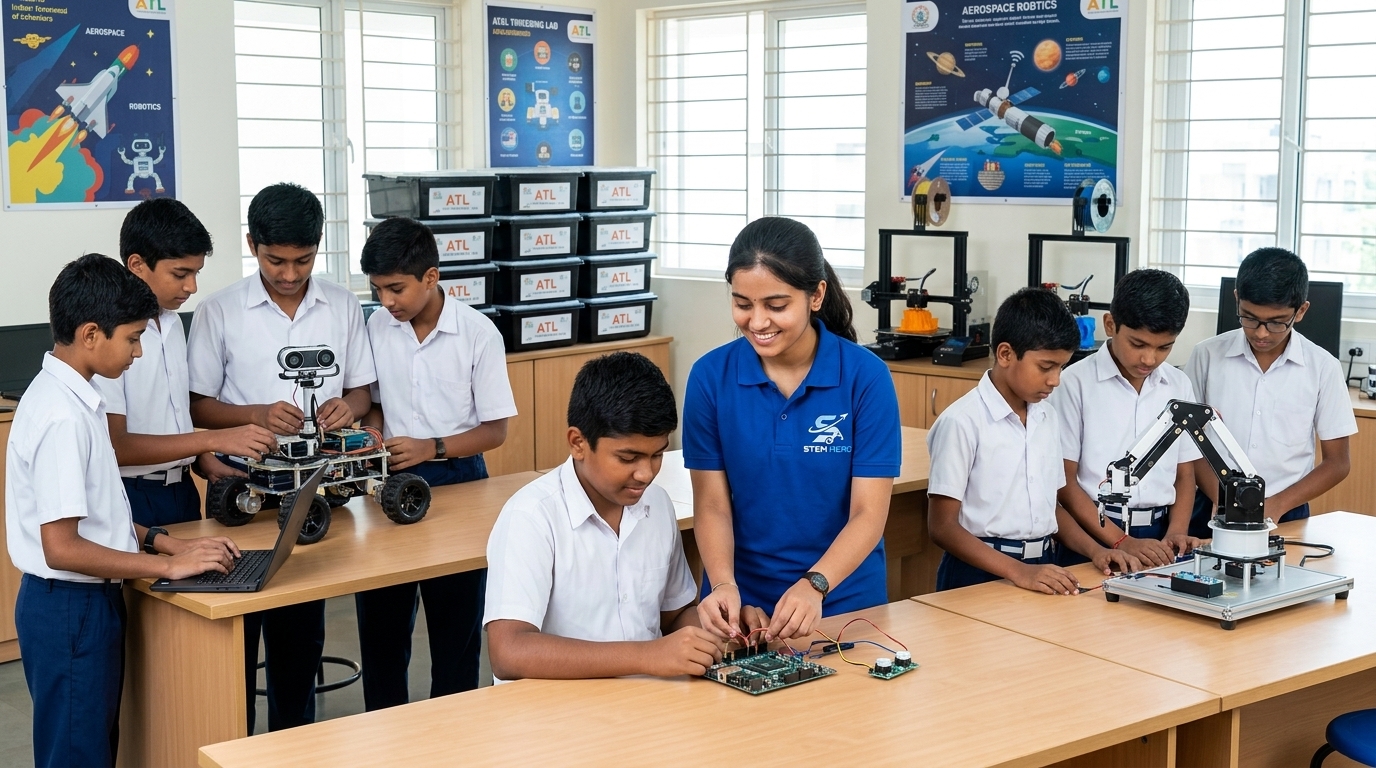
Certified, highly trained robotics mentors stationed directly at your school campus to run regular timetabled practical sessions with zero recruitment overhead.
STEM AERO empowers schools with dedicated robotics trainers, a continuous 10-year progressive curriculum (Classes 3 to 12), and turnkey AI & ATL innovation lab setups.
Experiential Learning Hub
We eliminate the operational friction for schools by providing end-to-end personnel, curricula, and innovation infrastructure.
Certified, highly trained robotics mentors stationed directly at your school campus to run regular timetabled practical sessions with zero recruitment overhead.
A structured 10-year progression for Classes 3 through 12, taking young students seamlessly from visual block drag-and-drop to neural networks and edge-AI.
Complete turnkey ATL-style innovation laboratories tailored to your school's physical space and budget, featuring safe workbenches, microcontrollers, and sensor arrays.
Carefully calibrated to grow with the child's cognitive maturity, from playful sensory discovery in primary grades to engineering AI models in senior secondary.
Everyday science, simple machines, force & motion, basic safe circuits, and visual drag-and-drop block coding.
Engineering design cycles, DC motors, analog/digital sensors, smart environmental gizmos, and introduction to microcontrollers.
Multi-sensor robotics, motor drivers, PID line following, smart home telemetry, and cloud dashboard integration.
Full Python syntax, data structures, autonomous rovers, ESP32 Wi-Fi modules, computer vision filters, and ML algorithms.
Mathematical neural networks, OpenCV computer vision pipelines, inverse kinematics, edge AI deployment, and capstone research.
Industry-Standard Technologies Taught Across Grades
Every single weekly session moves through an intentional instructional sequence designed to turn passive listeners into active inventors.
Interactive real-world hook unpacking the physics or computing law.
Trainer demonstrates working hardware benchmark & test cases.
Students assemble physical circuits, sensors, and mechanical gears.
Students write logic blocks or code routines to drive actuators.
Open-ended bug or scenario forcing creative troubleshooting.
Journal documentation, peer demos, and engineering takeaway.
Scientifically balanced classroom distribution for maximum retention and creative problem-solving.
Intuitive, visual explanation of electronic, mechanical, and algorithmic concepts.
Tactile wiring, microcontroller flashing, component assembly, and code debugging.
Original student-led design sprints, robotics obstacle courses, and prototype tests.
We solve the real challenges principals and administrators face when launching high-tech innovation programs.
No dry blackboard lectures. Every student builds and operates physical hardware in every single class.
Child-safe 5V–9V DC modular kits, short-circuit protection, zero 230V mains shock risk for students.
Experienced engineering graduates trained in child psychology and practical classroom pedagogy.
Flexible modular plans customized to school infrastructure and student strength without heavy capital locks.
No disjointed one-off kits. A structured, progressive 10-year roadmap from Class 3 to Class 12.